BIM Career After Civil Engineering
Civil engineering graduates already have a foundation in subjects such as building construction, structural systems, surveying, materials, estimation, and project execution.BIM training adds another layer to this knowledge.Instead of only understanding how a building is constructed, you learn how the project can be digitally represented, documented, coordinated, and reviewed.
A typical career progression can look like:
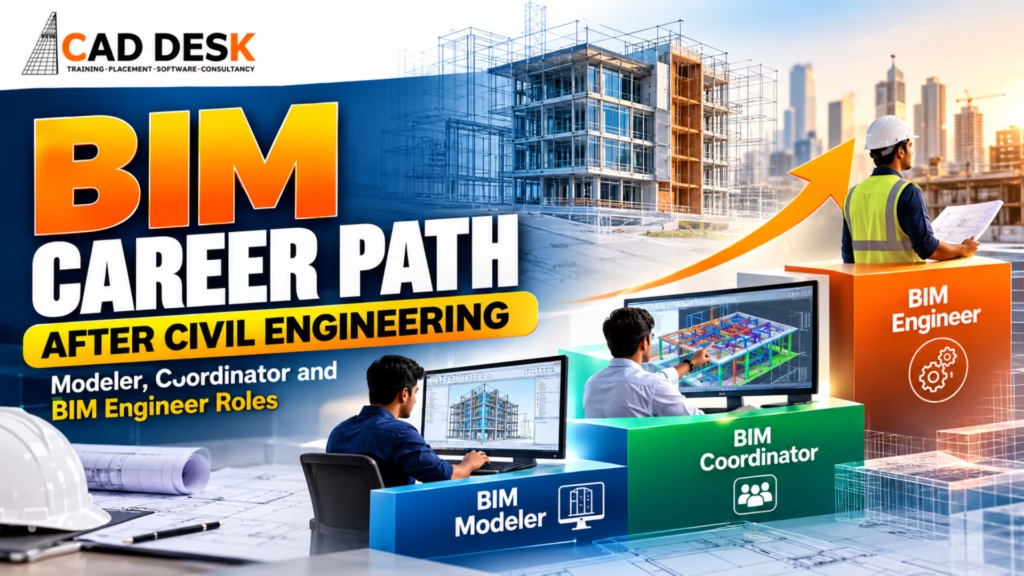
Civil Engineering Graduate → BIM Trainee → BIM Modeler → BIM Engineer → BIM Coordinator → BIM Lead / BIM Manager
The exact designation varies between companies. Some organizations may use titles such as Revit Modeler, BIM Technician, BIM Engineer, Design Engineer, or BIM Coordinator for similar responsibilities.Let’s look at these roles individually.
1. BIM Modeler
The BIM Modeler is one of the common starting points for graduates entering the BIM field. A BIM Modeler creates digital building models based on architectural, structural, or MEP drawings and project requirements. For a civil engineering graduate, the role may involve creating structural or architectural elements using BIM software.
Typical responsibilities
A BIM Modeler may work on:
- Creating 3D building models
- Developing walls, floors, doors, windows, roofs, and other elements
- Creating structural components
- Setting up views and sheets
- Preparing construction documentation
- Updating models based on design changes
- Maintaining model accuracy
- Following project standards
- Coordinating with senior engineers and designers
Skills required
A BIM Modeler should have:
- Basic civil engineering knowledge
- Understanding of construction drawings
- Revit knowledge
- Knowledge of architectural or structural elements
- Drawing interpretation skills
- Basic documentation knowledge
- Attention to detail
- Ability to follow project standards
For beginners, becoming a BIM Modeler can provide practical experience before moving into coordination and engineering responsibilities.
2. Revit Modeler
Revit is one of the commonly used BIM platforms in the AEC industry. A Revit Modeler works primarily with Autodesk Revit to create and manage digital building models. Depending on the company, a Revit Modeler may work in architecture, structure, or MEP. For civil engineering graduates, structural and architectural Revit workflows can be particularly relevant.
What does a Revit Modeler do?
Typical work includes:
- Creating project models
- Setting up levels and grids
- Modeling building components
- Creating views
- Preparing sheets
- Creating schedules
- Developing families
- Updating design changes
- Checking model information
- Supporting documentation teams
Learning Revit alone is useful, but understanding why different building elements are modeled in a particular way is equally important. A student who understands both civil engineering concepts and Revit workflows can build a stronger foundation for BIM-related positions.
3. BIM Engineer
The role of a BIM Engineer can involve more technical responsibility than an entry-level modeling position. The exact responsibilities depend on the company and project.
A BIM Engineer may be involved in:
- Developing detailed BIM models
- Reviewing model quality
- Supporting design teams
- Preparing project documentation
- Working with BIM standards
- Coordinating model changes
- Supporting clash detection
- Working with multiple disciplines
- Assisting project teams with BIM workflows
A BIM Engineer should understand both software and construction processes.
This is why simply learning software commands may not be enough.
A good BIM training program should connect software skills with actual construction situations.
4. BIM Coordinator
The BIM Coordinator works between different project disciplines. A building project may have separate architectural, structural, electrical, plumbing, and HVAC models. The BIM Coordinator helps identify coordination problems between these disciplines. For example, an HVAC duct may pass through a structural beam. A plumbing pipe may conflict with another service. Equipment may not have enough space for installation. These issues can be identified during digital coordination before they become construction problems.
BIM Coordinator skills
Some important BIM coordinator skills include:
- Strong understanding of BIM workflows
- Knowledge of Revit
- Model review skills
- Clash detection
- Coordination between disciplines
- Understanding of construction drawings
- Communication skills
- Problem-solving
- Documentation
- Understanding of project standards
A BIM Coordinator should not only identify a clash but also understand the project context and communicate the issue clearly to the relevant team.
5. BIM Technician
A BIM Technician generally focuses on the technical production side of BIM projects.
Depending on the organization, the role can include:
- Model development
- Drawing production
- Revit documentation
- Model updates
- Sheet creation
- Family creation
- Maintaining project standards
- Supporting BIM Engineers and Coordinators
This can be another entry point for graduates who want to gain practical BIM experience.
With experience, technicians can move into more specialized modeling, coordination, or management roles.
6. BIM Manager
BIM Manager is generally a more experienced position.
The role involves managing BIM processes across projects or teams.
Responsibilities may include:
- Developing BIM standards
- Managing BIM execution processes
- Establishing project workflows
- Reviewing model quality
- Managing coordination
- Supporting project teams
- Managing BIM deliverables
- Training team members
- Coordinating with clients and consultants
A BIM Manager needs more than software knowledge.
Leadership, project management, communication, standards, documentation, and industry experience become increasingly important at this stage.
Therefore, students should consider BIM Manager as a long-term career goal rather than an immediate entry-level position.
What Should You Learn in a BIM Course?
A useful BIM course should go beyond basic software demonstrations.Students should ideally learn through a combination of theory, software practice, and project work.
A structured learning path may include:
1. Construction Fundamentals
Understand:
- Building components
- Construction methods
- Architectural drawings
- Structural drawings
- Basic MEP concepts
2. Revit Modeling
Learn how to create and manage BIM models.
3. Documentation
Learn how models are converted into:
- Plans
- Elevations
- Sections
- Details
- Schedules
- Sheets
4. Coordination
Understand how multiple disciplines work together.
5. Clash Detection
Learn how coordination issues can be identified using appropriate tools.
6. Project Standards
Understand naming, modeling, documentation, and project organization.
7. Portfolio Development
Create projects that demonstrate practical skills instead of showing only course certificates.
BIM Portfolio Projects for Civil Engineering Students
A portfolio can make a significant difference when applying for entry-level positions.Instead of showing only screenshots of individual Revit commands, create complete project examples.For example, you could develop a residential building project.
The portfolio can include:
Project 1: Residential Building BIM Model
Include:
- Floor plans
- 3D model
- Elevations
- Sections
- Door and window schedules
- Material information
- Sheets
Project 2: Structural BIM Model
Include:
- Columns
- Beams
- Slabs
- Foundations
- Structural plans
- Sections
- Schedules
Project 3: BIM Coordination Project
Combine multiple models and demonstrate:
- Architectural model
- Structural model
- MEP model
- Clash identification
- Coordination screenshots
- Issue documentation
A portfolio like this gives an interviewer something specific to discuss.
What Employers May Look for in BIM Freshers
A common mistake among students is focusing entirely on certificates.A certificate can show that you completed a course, but it does not automatically demonstrate your practical ability.
During recruitment, employers may look at:
- Revit knowledge
- Understanding of drawings
- BIM concepts
- Modeling accuracy
- Construction knowledge
- Documentation skills
- Coordination understanding
- Portfolio projects
- Communication
- Problem-solving
- Willingness to learn
For BIM jobs for civil engineers, the combination of engineering knowledge and digital skills can be particularly useful.
BIM Jobs in Bangalore for Civil Engineering Graduates
Bangalore has a large ecosystem of companies working across architecture, engineering, construction, infrastructure, real estate, and technology-supported construction services.For someone planning a BIM career after civil engineering, Bangalore can provide exposure to different types of AEC projects.
Depending on the organization, job descriptions may include positions such as:
- BIM Modeler
- Revit Modeler
- BIM Engineer
- Structural BIM Engineer
- Architectural BIM Modeler
- BIM Coordinator
- Revit Technician
- BIM Technician
- MEP BIM Modeler
The responsibilities and requirements vary by company.
Marathahalli is also a practical location for students looking for technical training because of its connection to several business and technology areas in East Bangalore.Students searching for a BIM Training Center in Marathahalli should therefore evaluate the course based on practical project exposure, software training, trainer experience, and portfolio support.
BIM Modeler Salary in Bangalore
Salary is one of the common questions students ask when considering BIM as a career.
The BIM Modeler salary in Bangalore can vary significantly depending on factors such as:
- Educational background
- Previous experience
- Software skills
- Project experience
- Discipline
- Company
- Job responsibilities
- Location
- Portfolio quality
Freshers and experienced professionals should not expect the same compensation.
A person with strong Revit skills, good drawing knowledge, coordination experience, and relevant project exposure may qualify for different roles than someone with only basic software training.
Instead of choosing a course based only on expected salary, students should focus on building skills that can help them qualify for progressively responsible roles.
How to Prepare for a BIM Interview
Preparing for a BIM interview requires both technical and practical preparation.
Revise Civil Engineering Fundamentals
Be comfortable explaining:
- Structural components
- Building components
- Construction processes
- Drawings
- Materials
- Basic project terminology
Practice Revit
Do not stop with watching tutorials.
Create models yourself.
Practice:
- Levels
- Grids
- Walls
- Floors
- Doors
- Windows
- Columns
- Beams
- Views
- Sections
- Sheets
- Schedules
Understand BIM Concepts
You should be able to explain:
- What BIM means
- Difference between CAD and BIM
- What a BIM model contains
- What coordination means
- What clash detection means
- Why BIM is used in construction
- How different disciplines coordinate
Prepare Your Portfolio
Keep a few complete projects ready.
Be prepared to explain:
- What you modeled
- Which software you used
- What challenges you faced
- How you solved them
- How the model was documented
- What you learned
This makes the interview more practical and gives the interviewer a better understanding of your capabilities.
CAD vs BIM: What Is the Difference?
Many civil engineering students already know AutoCAD, so they naturally ask whether BIM is different from CAD.The basic difference is that CAD is primarily focused on creating drawings, while BIM involves creating information-rich digital models and managing project information.For example, a CAD drawing may show a wall using lines.In a BIM model, the wall is an actual building element with properties and relationships to other project components.BIM therefore extends beyond drawing production.For civil engineering professionals, learning BIM can complement existing CAD knowledge rather than completely replacing it.
How to Choose a BIM Training Center in Marathahalli
If you are searching for a BIM Training Center in Marathahalli, compare institutes based on what you will actually learn and practice.
Look for:
Practical Training
Ask whether students work on complete projects instead of only individual software exercises.
Software Coverage
Check whether the course covers the tools relevant to your intended role.
Industry-Oriented Projects
Projects should resemble the type of work performed in real AEC environments.
Portfolio Support
The institute should help you build work that can be presented during interviews.
Trainer Experience
Ask about the trainer’s practical industry experience and project knowledge.
Interview Preparation
Mock interviews, resume guidance, and technical interview preparation can help freshers prepare for job applications.
Batch Structure
Check the class schedule, duration, practical hours, and whether students receive sufficient hands-on practice.
These factors are generally more useful than choosing an institute only because it advertises a large number of software tools.
BIM Career Growth: What Comes After the First Job?
BIM is not a single job position. It can develop into several career directions.
After gaining experience as a modeler, professionals can move toward:
Modeling → BIM Engineering → Coordination → BIM Management
Others may specialize in:
- Structural BIM
- Architectural BIM
- MEP BIM
- Infrastructure BIM
- BIM coordination
- BIM standards
- BIM automation
- Digital construction
The direction depends on individual interests and project opportunities.
For example, someone who enjoys technical modeling may prefer to specialize in structural BIM, while another person may be more interested in coordination and project management.
Skills That Can Help You Grow in BIM
Software knowledge is only one part of a successful BIM career.
Some of the most useful skills include:
Technical Skills
- Revit
- AutoCAD
- Navisworks
- BIM documentation
- Model coordination
- Clash detection
Engineering Skills
- Construction knowledge
- Drawing interpretation
- Structural understanding
- Architectural understanding
- Building systems knowledge
Professional Skills
- Communication
- Teamwork
- Problem-solving
- Time management
- Attention to detail
As your career progresses, communication becomes increasingly important because BIM projects involve multiple teams.
Common Mistakes Students Make While Learning BIM
Learning Too Many Software Tools
Learning ten applications at a basic level may not be as useful as becoming confident in the tools required for your target role.
Focusing Only on Certificates
Certificates are useful, but practical work demonstrates your skills more clearly.
Ignoring Drawing Reading
BIM professionals need to understand the drawings and project information behind the model.
Not Building a Portfolio
A portfolio helps employers see what you can actually produce.
Learning Commands Without Understanding Construction
Knowing where a Revit button is located is different from understanding why and how a building element should be modeled.
Avoiding Coordination Skills
As you progress in your career, coordination becomes increasingly important.
BIM Career Path After Civil Engineering: A Practical Roadmap
If you have completed civil engineering and want to enter BIM, you can follow this roadmap:
Step 1: Strengthen Civil Engineering Basics
Revise construction concepts and drawing reading.
Step 2: Learn AutoCAD
Understand 2D drawings and drafting workflows.
Step 3: Learn Revit
Start with architectural or structural modeling depending on your career interest.
Step 4: Understand BIM Workflows
Learn how models, drawings, documentation, and project information are connected.
Step 5: Learn Coordination
Explore model federation and clash detection.
Step 6: Build Projects
Create complete residential, commercial, or structural projects.
Step 7: Prepare Your Portfolio
Show your models, drawings, sheets, schedules, and coordination work.
Step 8: Prepare for Interviews
Revise technical concepts and practice explaining your projects.
Step 9: Apply for Entry-Level BIM Roles
Look for suitable positions such as BIM Trainee, BIM Modeler, Revit Modeler, BIM Technician, or junior BIM-related roles.
Step 10: Continue Learning
After gaining professional experience, consider moving toward BIM Engineer, BIM Coordinator, or specialized BIM roles.
Frequently Asked Questions About BIM Careers
What career options are available after learning BIM?
After learning BIM, civil engineering graduates can explore roles such as BIM Modeler, Revit Modeler, BIM Technician, BIM Engineer, BIM Coordinator, and eventually BIM Manager. Specialized opportunities are also available in architectural, structural, MEP, and infrastructure BIM depending on skills and experience.
Is BIM a good career option after civil engineering?
BIM can be a career path for civil engineering graduates who are interested in digital design, construction technology, modeling, documentation, and project coordination. The career path depends on individual skills, experience, specialization, and the requirements of employers.
Which software should a civil engineer learn for BIM?
Revit is an important starting point for many building BIM workflows. Depending on the role, students may also learn AutoCAD, Navisworks, visualization tools, and other applications used within specific project workflows.
Can a fresher get a BIM job?
Freshers can apply for entry-level BIM positions if they have relevant software knowledge, construction fundamentals, drawing-reading ability, and practical project work. Building a portfolio can help demonstrate these skills.
What skills are required for a BIM Coordinator?
Important BIM Coordinator skills include BIM workflow knowledge, Revit, model review, clash detection, multidisciplinary coordination, communication, documentation, and problem-solving.
What is the BIM Modeler salary in Bangalore?
BIM Modeler salaries in Bangalore vary based on experience, technical skills, discipline, company, responsibilities, and project exposure. Freshers and experienced professionals can have significantly different compensation levels, so salary should be evaluated based on the specific job and experience level.
Is Revit enough for a BIM career?
Revit can provide a strong foundation, but a BIM career involves more than software operation. Understanding construction, drawings, documentation, coordination, BIM processes, and project standards is also important.
How long does it take to learn BIM?
The time required depends on your existing civil engineering knowledge, software experience, learning schedule, and the depth of training. Learning basic modeling is different from becoming job-ready for coordination or engineering responsibilities.
Should civil engineers learn BIM?
Civil engineers interested in digital construction, building modeling, design coordination, and construction technology can consider learning BIM. It can complement traditional civil engineering knowledge with digital project skills.